

MARKET SUMMARY 11-30-2022
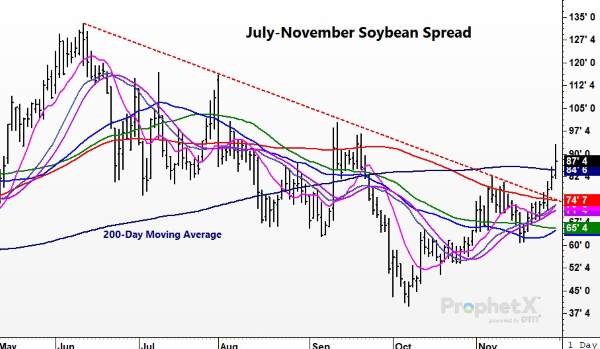
Spreads in grain markets can help dictate the overall strength or weakness in a certain market. Recently, the soybean market has seen buying strength, and a noticeable area of this strength is in the old crop/new crop soybeans spreads. One example is the July/November soybean spread, where traders are buying the front-end July soybean futures and selling November against it. This week, this spread has pushed through trendline resistance over top of the charts on bullish support. The old crop/new crop spread is pitting the tight front-end supply and domestic demand against a potentially larger global soybean supply in the future. For old crop soybeans, the market is anticipating strong domestic demand for the crush and export competition to support the futures, but the expectations of a record Brazil soybean crop is limiting the upside potential of the November contract. This week the strong move on the spread shows end users wanting to secure soybean supplies, helping lift the near-term soybean futures higher. Bull spread markets, like this spread reflects, are typically the sign of good front end demand.
Like what you’re reading?
Sign up for our free daily TFM Market Updates and stay in the know!
CORN HIGHLIGHTS: Corn futures traded both sides of steady, eventually finishing with small losses despite higher wheat, soybean, and energy prices. Dec lost 3-3/4 cents to close at 6.52 and Mar gave up 2-1/2 to end the session at 6.67. Dec 2023 lost 5 cents to close at 6.06-1/2. Managed money has been steadily moving out of long corn and this may have been the case again today or spread traders were buying wheat and beans and selling corn. A slower ethanol grind may have added some pressure to corn.
There was 102 mil bu of corn used for this past week’s ethanol grind, or 14.63 mil bu per day. In the first 12 weeks of the marketing year, corn usage has reached 1.202 billion bu, an annualized pace of 5.102 bb. If last week’s pace were to hold over the remaining 40 weeks of the marketing year, corn usage would reach 5.284 bb, just above the current USDA forecast of 5.275 bb. The growing concern in the corn market is an absence of exports and speculative buying interest. Holding prices together is a lack of farmer selling and a friendly macro picture, which would suggest there is still plenty of time for exports to rebound. Dry conditions in Argentina and a forecast suggesting much the same for the next few weeks are also supportive. The House passed legislation today that would form a tentative rail agreement to avoid a national strike. President Biden has said a rail shutdown would “devastate” the economy. Resistance near term is near 6.75 Dec futures and support at 6.510.
SOYBEAN HIGHLIGHTS: Soybean futures closed higher again today breaking out of the sideways range they have been in since the beginning of November. Crude rose nearly 2.50 a barrel, but those gains didn’t help bean oil which closed 1.31 lower to 75.23 for Dec, but meal had solid gains. Jan soybeans gained 10 cents to end the session at 14.69-1/2, and Mar gained 9-1/2 cents at 14.75-1/2.
Soybeans and meal closed solidly higher, while bean oil slipped on the open and ended closing lower. Crude has been moving higher over the past 3 days since OPEC started discussing production cuts which have been beneficial to the soy complex. Domestic demand for bean oil as biofuel has been ramping up and in turn has contributed to extremely high crush margins prompting processors to buy cash beans which has also helped keep basis firm. This morning another flash sale was announced of 5 mb to China for the 22/23 delivery period. There has been some concern that China would hold out for new crop Brazilian beans, but they have continued purchasing from the U.S. for now. The Brazilian crop is now 90% planted and done so under some of the best conditions they could have hoped for. Central and northern Brazil are forecast to receive rain over the next two weeks, while southern Brazil and Argentina are very hot and dry. Argentinian farmers have received an extension of September’s soy dollar which gives them a favorable peso to dollar exchange rate and prompted massive farmer selling. The program this time has been less successful with only 299,000 mt of soy products being sold today. Mar soybeans have broken out of their range higher and at the top of their Bollinger Band.
WHEAT HIGHLIGHTS: Wheat futures bounced today and may be correcting from an oversold situation. A decline in the U.S. dollar also eased pressure on the market. Mar Chi gained 14 cents, closing at 7.95-1/2 and Jul up 11-3/4 at 8.08-3/4. Mar KC gained 12-3/4 cents, closing at 8.99-3/4 and Jul up 12 at 8.83-3/4.
Wheat was finally able to make a recovery today in all three U.S. futures classes, and Paris milling futures traded higher as well. There wasn’t much news to propel this move higher, but a weaker U.S. dollar, higher outside markets, and the oversold nature of wheat futures may have all played a part. Additionally, crop conditions remain questionable at 34% good to excellent (up 2% from last week) but that is the second-lowest rating in 19 years. The poor to very poor category is at 26% and emergence is at 91%. In other news, today the U.S. house of representatives approved a deal to avert the rail strike – as of this writing, this is being passed on to the senate which still needs to vote. The deadline for the strike is December 9 so this is a critical time. The other factor that continues to affect wheat is the situation in the Black Sea. Both Russian and Ukrainian wheat prices are below the U.S. and it is hurting U.S. export demand. Turkey was said to have purchased 455,000 mt with the origin likely to be Russia. As a final point of note, wheat was able to trade higher today despite no help from the corn market – this is an encouraging sign.
CATTLE HIGHLIGHTS: Live cattle futures saw buying strength on Wednesday led by improving cash bids and corn market weakness. Dec finished 0.400 higher to 153.075, and Feb gained 0.875 to 155.675. Feeders saw strong buying strength as Jan feeders gained 2.475 to 180.475.
The cash market started to develop on Wednesday as bids firmed from Tuesday’s initial offerings. Late bids in the South on Tuesday started at $154, but those were passed over. Bids firmed to $155 and that triggered some cash trade. This was steady with last week. In the North, the market was slower to develop, bids were $157-158, which have been passed on at this time. Northern trade will likely develop later in the week. The cash trade holding firm is a victory as the retail market has softened, tightening packer margins. Beef prices were lower at midday as choice carcasses slipped 2.51 to 252.23 and select lost 0.43 to 225.39 on light movement of 84 midday loads. The USDA will release weekly export sales numbers on Thursday morning, and the market will be watching the pace of export demand, which has also softened recently but is still strong year-over-year. Feeders traded sharply higher, fueled by a jump in the cash index this week and a weak corn market. The Feeder Cattle Index jumped over $5.00 higher to start the week. Today, the index slipped 0.35 to 178.85. The strong movement in the feeder market on Wednesday pushed the futures back to a premium to the index, which could limit near-term gains. Feeder prices broke support this week but saw short covering on Wednesday. Price action is improved but follow through will be key. Strong price recovery led by cash markets on Wednesday. The market feels well supported given the supply picture, but the weakening retail market may limit the gains.
LEAN HOG HIGHLIGHTS: Lean hog futures saw good buying strength, fueled by short covering based on a firmer retail and cash tone and optimism for the Chinese demand with the potential loosening of COVID restrictions. Dec hogs gained 1.825 to 82.900 and Feb added 1.200 to 86.350.
The technical picture improved as the Feb contract posted a bullish reversal on the charts trading outside yesterday’s trading range and finishing with a firm tone. This could signal a significant low in the market for a turn higher, but follow-through over the next few sessions will be a key. At least today sellers dried up, opening the door for the price turn. Fundamental news was also supportive of the price move on the day. Direct cash trade was firmer on Wednesday gaining 4.16 to 86.20 and a 5-day rolling average of 84.73. The Lean Hog Index was softer, losing another 0.42 to 84.21. The cash index holds a 2.650 premium to the futures, which could provide support for the front month contract. Retail values at midday today were firmer, gaining 2.52 to 88.20, rebounding from a difficult close on Tuesday. The load count was moderate at 180 loads. The Pork Carcass Index maintained its tumble, losing 1.47 to 88.67. but the market is optimistic for a seasonal turn higher. The estimated slaughter for today was 494,000 head, up 2,000 from last week, and 15,000 over last year. Despite the firm numbers, hog weights are trending under last year, helping maintain the product supply. The Iowa/S. Minnesota weekly hog weights for the week ending November 26 has weights at 285.1 pounds vs. 284.4 pounds last week and 290.8 pounds a year ago The fundamentals still keep the front of the market limited, but the market is hoping for a seasonal turn. Cash has been trying to find some footing, now if the retail market would join the trend, a rally could have some true support.
DAIRY HIGHLIGHTS: It is looking more and more likely that the strong rally in cheese at the start of November was a quick holiday buying spree. From November 1 to November 15, cheese was bid higher eight out of eleven days. Since that time, the spot cheese average price has closed sideways or lower for ten straight sessions. Essentially, the market rallied 19.625c and has now given back 19.75c of that rally to hit its lowest price since September. The downtrend in cheese daily is keeping Class III futures under pressure. February 2023 Class III milk has closed lower 12 sessions in a row and most other contracts are creating a large down streak of their own. With November 2022 milk now off the board, there are no $20 milk futures on the board for Class III until the June ’23 contract. The market is stuck in a lull, but is getting oversold. Class IV is also struggling, with weaker powder demand the past few sessions.
Total Farm Marketing and TFM refer to Stewart-Peterson Group Inc., Stewart-Peterson Inc., and SP Risk Services LLC. Stewart-Peterson Group Inc. is registered with the Commodity Futures Trading Commission (CFTC) as an introducing broker and is a member of the National Futures Association. Stewart-Peterson Inc. is a publishing company. SP Risk Services LLC is an insurance agency. A customer may have relationships with all three companies. TFM Market Updates is a service of Stewart-Peterson Inc. Futures and options trading involve significant risk of loss and may not be suitable for everyone. Therefore, carefully consider whether such trading is suitable for you in light of your financial condition.
Author

John Heinberg