

MARKET SUMMARY 3-22-2023
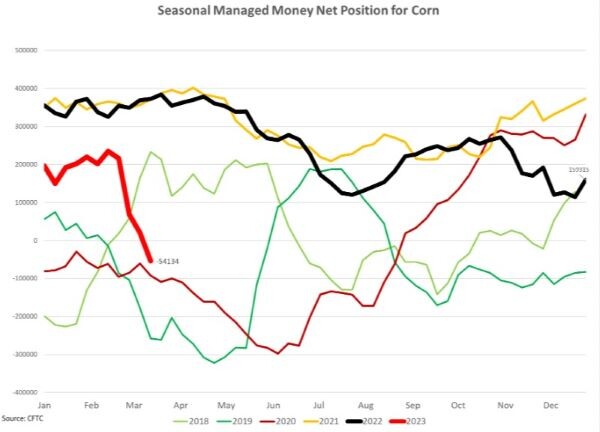
While the information from the CFTC regarding the Commitment of Traders has been delayed due to a ransomware attack, the managed funds positioning on corn has been liquidated. For the latest report for March 14, the managed funds have moved to a short position in corn of 54,134 net short contracts. This position is down a net 288,000 contract from a net long of 215,928 net long positions on the Feb 19 report. This was a historic sell-off as the fund grew an aggressive short position while liquidating held long contract. The fund has been influenced by the concerns of a growing supply of corn as demand concerns have seen the USDA add bushels to the ending stocks. In addition, the macro-economic environment has turned negative and deflationary, pressuring the commodity markets in general. The recent concerns regarding the stability of the banking sector have added to the “risk-off” mindset.
Like what you’re reading?
Sign up for our free daily TFM Market Updates and stay in the know!
CORN HIGHLIGHTS: Corn futures ended the session mixed. May gained 3-1/2 cents to close at 6.33-1/2, and December lost 2-1/4 to end the session at 5.54-1/2. Sharp losses in wheat and soybeans weighed on futures in the mid-morning trade with May trading as much as 6-3/4 cents lower. Yet stronger energy and another announced sale of corn to China this morning provided underlying support for the old crop. Today’s sale figure is near 7 mb making it near 90 mb since the beginning of last week. Bull spreading was a noted feature in today’s trade.
As the end of the month approaches, attention will focus on acres and quarterly stocks. A generally mild winter could suggest that feedlots did not use as much corn as the USDA may have Estimated. So, a concern is that feed usage will be lighter and quarterly stocks stronger. Yet basis levels in the West continue to run strong and improved basis this past week would suggest the market has seen the effects of increased exports as well as feed users wanting to cover more needs on this recent price drop. Yet, the entire commodity complex is under assault as managed money looks for a home elsewhere. It doesn’t appear the market is overly concerned world supplies of wheat or corn will be too tight that rationing has to occur. Perhaps the continuation of the Black Sea corridor remaining open for at least the next 60 days has been a negative catalyst in outside markets. Soybean harvest in Brazil is also a big factor pressuring bean prices with what should be a record Brazil’s soybean crop. Expect bull spreading to continue as long as the export market remains active. New crop prices could struggle as the drought monitor map continues to show signs of shrinking. It is too early to draw conclusions about prevent plant or a late start to the planting season for the majority of corn producers.
SOYBEAN HIGHLIGHTS: Soybean futures closed sharply lower again today along with bean oil and meal. Funds continue to liquidate their large net long positions and today’s Federal Reserve rate hike announcement put pressure on the soy complex as well. May soybeans lost 18-1/2 cents to end the session at 14.48-1/2, and Nov lost 23-1/2 cents at 12.72-1/2.
The soy complex fell sharply again in large part due to funds liquidating their long positions but harvest in Brazil and possible demand issues in China adding to pressure too. Today the Fed announced a rate hike of 25 basis points and signaled that further hikes would not be ongoing but “when appropriate” and that the banking issues may end up working in a similar way as the hikes. The latest CFTC data that had previously been delayed has shown funds as sellers of 29,669 contracts reducing their net long position to a still big 127,661 contracts. Funds are now net short both corn and wheat and the large net long position in beans is vulnerable to continued selling. Brazil’s harvest is chugging along and putting fresh supplies on the market which isn’t helping Us prices, but China may be buying less beans right now anyways. May beans on the Dalian exchange have fallen to a 7 month low at the equivalent of $16.40 a bushel possibly to do with the spread of ASF in the country. Bean meal continued to slide lower as the concerns about China’s feed demand continue. May beans closed below their 200-day moving average for the first time this year while Nov remains well below all its moving averages but came very close to closing its gap on the chart today at 12.69-1/4.
WHEAT HIGHLIGHTS: Wheat futures closed sharply lower as momentum continues to carry prices lower and outside market concerns weigh on commodities. May Chi lost 19-3/4 cents, closing at 6.63-1/2 and Jul down 17-3/4 at 6.74-3/4. May KC lost 9 cents, closing at 8.11-1/4 and Jul down 7-1/2 at 7.99-1/4.
It was another rough day for wheat with sharp losses for both US futures and Paris milling wheat futures. The extension of the Black Sea grain deal, banking industry issues, and recession fears are all weighing on the commodity markets. The Fed did announce another 25 basis point rate increase today but the bigger concern may be what they do down the road. There are a few bullish items out there to take note of, however. For example, it was recently reported that wheat in India was damaged by hail and torrential rains. There is also concern about Australia’s crop in the not too distant future, as the weather pattern shifts from La Nina to El Nino. Additionally, the drought in the US southern plains should provide some support for the market. Despite all of these things, though, the market doesn’t seem to care all that much. With funds said to be short about 98,000 contracts of Chicago wheat as of March 14 it is certainly possible that they may continue to push the market lower. On the other hand, it does leave them vulnerable to any bullish changes with the Ukraine war, weather, or any other unpredictable events. As a reminder, on March 31 traders will get both the quarterly grain stocks and acreage intention reports and these have the chance to be market movers.
CATTLE HIGHLIGHTS: Cattle futures traded lower on the day as the commodity market and the livestock sector in general are pressured by risk-off trade. Cattle futures charts are technically weak, and cash trade looks to trend lower this week adding to the selling pressure. Apr live cattle slipped 0.125 to 162.300 and Jun lost 0.250 at 155.900. March Feeder cattle lost 0.525 closing at 188.250 and Apr was down 0.325 to 194.375.
The livestock is under pressure as the market continues to liquidate long positions. The latest Commitment of Traders report saw fund positions reduce its current net long position to approximately 95,000 net long contracts, down about 20,000 net longs week over week. This has lined up with the recent peak in the charts. Cattle prices have been under pressure as money is flowing out of the commodity space in general. The cattle position is relatively long and susceptible to additional selling pressure. Cash trade is still undeveloped on the week, but bids are looking softer at $163 compared to last week. Trade will likely develop later in the week, but the expectation is softer. Retail values were mixed at midday. Packers have a little meat on the bone with margins approximately $50/head. Tuesday’s cattle slaughter 127,000 head vs. 127,000 head last week and 123,000 head last year. Week to date slaughter is 252,000 head vs. 252,000 head last week and 240,000 head last year. Choice carcasses were 2.28 higher to 282.20, but Select lost 1.95 to 269.60. The load count was light at 95 loads. Weekly exports sales will be released on Thursday morning, and the market will be watching the export demand totals. Feeder cattle saw moderate losses, tied to the live cattle trend. The Feeder cash index was 0.93 lower 187.78, holding a discount to the futures, but trending lower. The cattle market is in correction, as prices trade softer. The longer-term fundamentals are still friendly, but the deflationary trade and seasonal weakness still pressure the cattle futures.
LEAN HOG HIGHLIGHTS: Hogs are still seeing consistent selling pressure as futures are still looking for a short-term low. A weak cash tone and retail values only helped the sellers strengthen their position. Apr hogs dropped 0.975 to 76.075, and Jun futures traded 0.200 lower to 91.350.
April hogs ended at new contract lows again today as the downward momentum continued, which helped lead the remaining hog contracts lower. Most of this selloff has been technical and driven by fund money keeping the pressure on the market, and buyers are looking for a reason to step in. The cash market was unreported today due to confidentiality, but the trend was lower going into the midday cash trade. The lean hog index lost .88 to 78.67 as the index trend is slowing or rolling over slightly. The index is now trading at a premium to the futures. hog retail values were 1.02 lower to 80.50, and the trend has been softer in the retail market as well. The load count was moderate at 232 loads. Traders will likely need to see a trend of higher cash and cutouts firm back up before buying into this market. Hog market have a tendency to want to V-bottom or V-top on strong moves. That could be possibility with the market in such an oversold condition.
DAIRY HIGHLIGHTS: In 2022, the US spot butter price rose to all-time highs up to $3.2675/lb at the peak. Tight inventories and extremely high export sales were the reason for the strength in the market. In 2023, the market has come back down to earth for the most part and has hovered at about $2.40/lb for most of the year. Inventories are back on the rise and butter production has recovered. With the butter price stagnant and the powder market continuing to push into new lows, the Class IV futures trade holds in a downtrend. Second month class IV sits at just $18.04 versus second month class III up at $19.36. This the widest the spread between III and IV has been in quite some time. In Wednesday’s trade, class III once again found support from a strong cheese trade that saw blocks bid back over the $2.00/lb level. Blocks closed up 3c to $2.0150/lb on 5 loads traded. Barrels lost 1.25c to $1.94/lb on 10 loads traded. Spot powder hit new lows for the year at $1.15/lb.
Total Farm Marketing and TFM refer to Stewart-Peterson Group Inc., Stewart-Peterson Inc., and SP Risk Services LLC. Stewart-Peterson Group Inc. is registered with the Commodity Futures Trading Commission (CFTC) as an introducing broker and is a member of the National Futures Association. Stewart-Peterson Inc. is a publishing company. SP Risk Services LLC is an insurance agency. A customer may have relationships with all three companies. TFM Market Updates is a service of Stewart-Peterson Inc. Futures and options trading involve significant risk of loss and may not be suitable for everyone. Therefore, carefully consider whether such trading is suitable for you in light of your financial condition.
Author

John Heinberg