

The insurance information below is provided by SP Risk Services LLC, an insurance agency. This article may not include all details of the programs mentioned. Prior to entering into any policies or binding coverage, be sure to speak with your agent about details concerning the programs mentioned that may affect your operation.
Active marketing can help dairy farmers like you build a solid price for what you sell and buy, and can also help protect you from the swings of the market. This is true whether you’re aiming to maximize the price you get from your production or to minimize the cost of your inputs. Realistically, however, you need to be smart and strategic about how you employ your marketing budget, especially since dairy farmers must consider commodity price risk on both inputs and sales.
The chart below outlines three distinct goals of a comprehensive marketing strategy and the tools available to you to help you achieve your goals. Every goal can be addressed with cash and futures marketing tools. Please take note of the last goal, protecting downside risk. It is the ONLY goal that can be addressed to a certain level using federally subsidized livestock insurance structured specifically for dairy farmers.
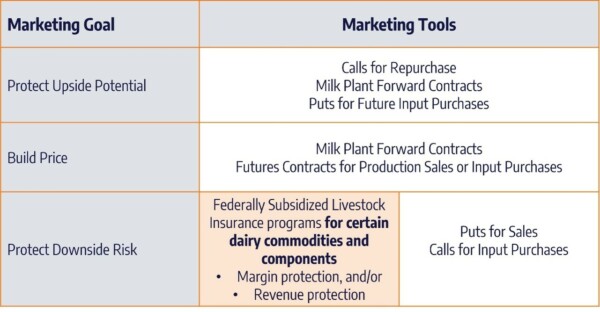
Unlike cash or futures tools, livestock insurance has some limitations, qualifications, and rules that you need to know. For instance, not all products are always covered, and certainly not all inputs are covered. However, as a foundational tool for a marketing strategy or even a first step into marketing, insurance programs for dairy may be hard to beat. They are subsidized, leaving more of your marketing budget available for other goals, and they are flexible to the needs of your operation. They also allow you to layer in other tools and strategies as you build your overall marketing strategy.
With that in mind, let’s take a deep dive into these very important USDA programs available to you.
Insurance Programs Help Offset Much of the Risk Dairy Farmers Take On
Two of the most popular insurance programs for dairy operations created through the USDA Risk Management Agency (RMA) are Dairy Revenue Protection and Livestock Gross Margin for Dairy.
Dairy Revenue Protection (DRP) is an insurance program established in 2018, intended to protect you from unexpected declines in a quarter’s revenue from milk or milk component sales by comparing current futures prices to a guaranteed level set when you bind coverage through an endorsement. Think of this insurance as a tool similar to a put option protecting a portion of your production from falling prices.
- DRP offers producers the option to choose between Class Pricing and Component Pricing.
- The Class Pricing option uses Class III prices, Class IV prices, or a combination of both to determine coverage and potential indemnities. This option is often used by producers who market milk based on class pricing formulas.
- The Component Pricing option uses component values such as butterfat, protein, and other solids to determine coverage and indemnities. This option may better reflect the milk checks of producers whose milk is marketed on a component basis.
- DRP is generally available whenever the commodity market is open, except on days USDA reports are issued.
- DRP may be an appropriate choice if your operation needs tailored coverage based on component pricing or combination pricing, or if potential quarterly indemnities meet the needs of your operation.
Livestock Gross Margin for Dairy (LGM-Dairy) is a 2006 insurance program intended to protect you from unexpected contractions in monthly margins (the difference between milk prices and feed prices). Squeezed margins could occur when milk prices fall and/or feed prices increase vs. the guaranteed level you set when you add an endorsement. LGM-Dairy is similar to purchasing a put option on a portion of your milk to establish a price floor, along with purchasing a call option on soymeal and corn to protect against rising feed costs. However, note that with LGM-Dairy, the indemnity is based on the difference in milk and feed prices.
- LGM-Dairy is a gross margin insurance program that calculates the difference between the market value of milk and feed costs.
- The program uses futures prices for Class III milk, corn, and soybean meal to determine both the expected gross margin and the actual gross margin.
- If the actual gross margin falls below the guaranteed margin selected by the producer, an indemnity payment is triggered.
- LGM-Dairy is offered any Thursday the commodity markets are open, except on days USDA reports are released.
- LGM-Dairy may be an appropriate choice if maintaining profitability is a chief concern and if you do not need the flexibility of component or Class IV pricing offered by DRP. It may also be appropriate if potential monthly indemnities meet the needs of your operation.
More Program Flexibility Offers You More Tailored Coverage
In past livestock years, the USDA Risk Management Agency (RMA) rules prevented dairy producers from utilizing DRP and LGM-Dairy coverage over any common timeframe. Because of these restrictions, producers typically had to choose one form of risk management coverage over the other, limiting their ability to combine the benefits of both programs.
Beginning on July 1, 2026, producers can utilize both DRP and LGM-Dairy during the same month. While there are still limitations and guidelines surrounding how the two programs can be combined, this change provides dairy producers with greater flexibility in building a comprehensive risk management strategy.
Using DRP and LGM-Dairy together allows producers to utilize both programs to “stack” coverage and build a more customized approach to risk management, especially with regards to protecting against downward risk. Remember to consider your marketing strategy to build price and capture upside potential for a comprehensive approach to risk management, as well.
There are some important limitations and restrictions you still need to pay attention to:
- Although you may now use both programs together, you are still limited to covering only your total milk production between the two programs. In other words, you cannot over-insure milk production by covering the same pounds of milk multiple times beyond their actual production history. These safeguards help maintain the integrity of the programs while still giving producers more flexibility to manage risk in volatile dairy markets.
- Both the DRP and LGM-Dairy policies must be written through the same insurer (Approved Insurance Provider, or AIP). This allows the AIP to properly track the total pounds of milk covered and ensure compliance with program rules. It also helps to reduce the risk of overlapping coverage and noncompliance of insurance policies.
An important unintended benefit of working through one AIP is that you can work more effectively with your agent when coordinating the timing and use of each risk management tool. This coordination can help maximize coverage opportunities, avoid unintended conflicts between policies, and create a more organized and efficient risk management strategy.
Enrolling in an Insurance Program
The first step in utilizing these programs is signing up with an approved insurance agent to establish a policy. This can be done through any licensed livestock insurance agent, including SP Risk Services of Total Farm Marketing. Once your DRP and LGM policies are in place, you will have the ability to utilize these programs when market conditions become favorable.
Both programs are highly time-sensitive, making it important to have all your policies and reporting requirements in place ahead of time so you can quickly secure coverage once target price levels are reached. DRP is available daily when the markets are open, and quotes remain valid until 9:00 a.m. Central the following day. LGM coverage, on the other hand, is only available on Thursdays, with prices also valid until 9:00 a.m. Central the next morning.
Because of these narrow windows, strong communication with your insurance agent is essential to securing timely coverage.
Taking Action Matters
Every day you take on market risk whether you’re paying attention or not. Ask yourself, do you want the market to manage you or do you want to manage the market? The good news is that the insurance programs now available for dairy farmers like DRP and LGM-Dairy make it easier than ever for you to affordably take control of your marketing.
With that in mind, remember that like any powerful tool, you need to use livestock insurance responsibly to get the most potential benefit. As always, reach out to trusted advisors and agents who can help you understand how the market is moving. Get educated on when and how to build price; learn when to sit tight and when to take action to combat market volatility.
At Total Farm Marketing, we are here to help you manage the market and to help you be successful, as we’ve helped farmers for over 40 years.
Do you have questions about expectations, market reactions, or our recommendations? We’re here to help.
Give Total Farm Marketing a call at 800.334.9779 to discuss your situation and how we can help you in your marketing decisions.
©June 2026. Total Farm Marketing. Futures and options trading involve significant risk of loss and may not be suitable for everyone. Therefore, carefully consider whether such trading is suitable for you in light of your financial condition. No representation is being made that scenario planning, strategy or discipline will guarantee success or profits. Examples of seasonal price moves or extreme market conditions are not meant to imply that such moves or conditions are common occurrences or likely to occur. Futures prices may have already factored in the seasonal aspects of supply and demand. The data contained herein is believed to be drawn from reliable sources but cannot be guaranteed. Reproduction of this information without prior written permission is prohibited. This material has been prepared by a sales or trading employee or agent of Total Farm Marketing and is, or is in the nature of, a solicitation. Any decisions you may make to buy, sell or hold a futures or options position on such research are entirely your own and not in any way deemed to be endorsed by or attributed to Total Farm Marketing. Total Farm Marketing refers to Stewart-Peterson Group Inc., Stewart-Peterson Inc., and SP Risk Services LLC. Stewart-Peterson Group Inc. is registered with the Commodity Futures Trading Commission (CFTC) as an introducing broker and is a member of National Futures Association. Stewart-Peterson Inc. is a publishing company. SP Risk Services LLC is an insurance agency and an equal opportunity provider. A customer may have relationships with any of the three companies.
SP Risk Services LLC is an insurance agency and an equal opportunity provider. Issuance of insurance coverage is subject to underwriting review and approval. SP Risk Services LLC is not licensed in all states. Please see the policy for the full terms, conditions, and exclusions. SP Risk Services LLC is an insurance agency licensed to sell certain insurance products and may receive compensation from insurance companies for such sales. Policy obligations are the sole responsibility of the issuing insurance company. Any coverage scenarios are hypothetical and shown for illustrative purposes only. Any claims made pursuant to any policy are adjusted by the issuing insurance company. Insured is responsible for accuracy of information provided to SP Risk Services and its insurance companies. The information included in or available through the website may include inaccuracies or typographical errors. SP Risk Services LLC may make changes or improvements to the website at any time. Information received via the website should not be the sole basis for risk management decisions. Consult a licensed insurance agent (which does not have to be an SP Risk Services LLC agent) for information and advice specific to your situation. Go to https://www.totalfarmmarketing.com/privacy-policy/ for Privacy Notice & Non-Discrimination Statement and https://www.totalfarmmarketing.com/terms-of-use/ for Terms of Use.
Author

Lauren VandenLangenberg