

A common belief is that June is a great time to sell corn.
It certainly can be. We took a look at post-Christmas trading days through the end of June over the past 20 years (which we’ll reference as planting season) and identified bull markets of 10% or greater. Seven of the past 18 bull markets peaked in June, which is the highest of any month and serendipitously right about the time most producers have finished planting and have time (theoretically) to focus on their marketing. However, that is only 39% of the time. Five of the rallies ended in May while three ended in July. In reality, markets and global events are completely unpredictable.
This brings us to 2026. This year’s rally began on January 14, two days after an extremely bearish January WASDE report, and accelerated when the war with Iran began at the end of February. Prices peaked on May 5 when you were busy planting (or trying to). Some of you may have made advantageous sales during that time and some may have been holding out for June. Now that we’re headed into July, regardless of how you are positioned, how should you be thinking about potentially maximizing the remainder of your crop sales now and in the future?
Understand the Nature of Rallies
Do you feel like you maximized your opportunity this year? If not, you’re not alone. It’s generally helpful as a marketer to understand how opportunities to capture rallies can be fleeting and narrow. Let’s do a quick deep dive into those 20 years of planting season rallies we referenced earlier, which occur post-Christmas to June 30. The market tends to offer one (and only one) rally of 10% or more off the market low, which has occurred 18 of the last 20 years. Rallies can begin as early as the beginning of January or as late as June, with seven of the 18 (or 39%) starting before the end of May.
On top of limited opportunity, you don’t always have a lot of time to react to a rally. It may creep up slowly so that you think you have time. Or you may think the market has a chance to rebound. Regardless, the market tends to fall far more quickly than it rises, which means that it’s easy to be lulled into a sense that you have more time than you have.
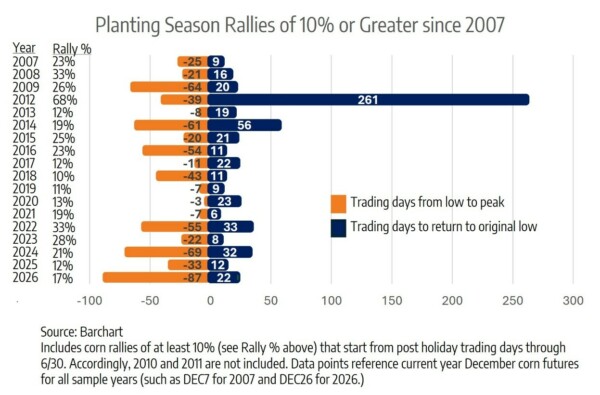
The chart above details over the last 20 years how many trading days that planting season rallies lasted (in orange) and how many days it took to return to the original low (in blue). The rise from the low to the peak of a rally lasts, on average, only 35 trading days with a range of 3 to 87 days. (The averages referenced here do not include 2012, which we’ve excluded from our calculations as an anomaly.) There were four rallies of more than 10% that lasted less than 10 trading days. Does that seem like a lot of time to make smart sales? Probably not.
Capturing a rally on the way down can be even more difficult. Unfortunately, the average sell-off back to the original low is only 19 trading days, ranging from 6 to 56 days (again, excluding 2012). To that point, take a look at the chart referenced above by focusing on the blue bars representing the number of trading days from the high back to the original rally low. You’ll note that in about two out of three times, the rallies depicted in orange were longer than the decline back to the original low.
This year’s rally is tied for the second shortest with 2018 in percentage terms to give back the entire rally. In both years, it only took 20% of the trading days to give back what was gained in the rally. The only year quicker in percentage terms was 2016 when the rally was erased in 17% as many days. In terms of actual days returning to the low, the 28% rally in 2023 may have been the most dramatic, giving back the entire move in only 8 trading days.
What, then, are you supposed to do?
At this point, you’ve seen that you really can’t anticipate the behaviors of a rally or a decline. You may be frustrated, wondering what you can do. Think about using a strategic approach that removes emotions from your decision-making and instead relies on a year-round, systematic approach regardless of whether you anticipate a rally or not.
Think in terms of your weighted average price for each crop. If you sell 20% and the market goes higher, 80% of the value of that crop is still increasing in value. Making a sale and having the market go higher should not be viewed as a mistake. It’s an opportunity to sell more bushels at an even better price.
You also need to focus on selling more than one crop year at a time. If it is a good time to be selling crop from last year that is in storage, it’s also probably a good opportunity to sell the crop you are going to produce this year. It may also make sense to sell some of the crop you are going to produce the following year. Consider always having more bushels to sell.
Finally, remember that your windows of opportunity to make advantageous sales may be exceptionally narrow. From the chart above, nine of the rallies lasted 25 trading days or less, and four of those lasted less than 10. If your goal is to sell in the upper half of the move, that could mean you only have a few days to sell the crop that is left over from last year and the bushels that need to be delivered at harvest.
Accordingly, we recommend that you consider the tools and strategies in the table below to help you capture price in both rising and falling markets. After all, producers tend to focus on markets that appear to be moving in your favor, yet limiting your marketing strategies only to rising markets may translate to missed opportunities to capture price in a falling market.
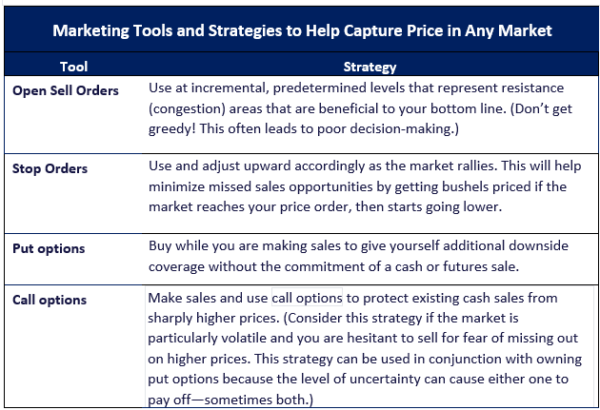
Bear in mind that these marketing tools and strategies, like all tools, offer both potential risks and rewards. Taking the time to understand how the tools work and associated risks before you enter into a position is crucial to helping you make a solid decision for your overall marketing approach. A trusted advisor can help.
For more information on stop orders and how they can be an integral part of your strategy, see Selling When Prices are Down, February 2023.
The Best Time to Think Strategically about Your Marketing Is Now.
It’s common for many, many producers to miss the opportunities of a rally. It might be that they’re distracted or believe the market will rebound. However, this is exactly the time when active marketing really matters. Waiting until harvest when prices are typically at their lowest rarely leads to anything but a low price. Opportunities to build price and minimize risk happen throughout the year, and being prepared to capitalize on them can make an impactful difference on what you bank.
At Total Farm Marketing, our consultants spend 100% of the day focused on the market, allowing farmers like you to focus on the job of farming. Talk to us about setting up a plan that can help you capture the highs, avoid the lows, and build a strong weighted average price.
Give Total Farm Marketing a call at 800.334.9779 to discuss your situation and how we can help you in your marketing decisions.
©July 2026. Total Farm Marketing. Futures and options trading involve significant risk of loss and may not be suitable for everyone. Therefore, carefully consider whether such trading is suitable for you in light of your financial condition. No representation is being made that scenario planning, strategy or discipline will guarantee success or profits. Examples of seasonal price moves or extreme market conditions are not meant to imply that such moves or conditions are common occurrences or likely to occur. Futures prices may have already factored in the seasonal aspects of supply and demand. The data contained herein is believed to be drawn from reliable sources but cannot be guaranteed. Reproduction of this information without prior written permission is prohibited. This material has been prepared by a sales or trading employee or agent of Total Farm Marketing and is, or is in the nature of, a solicitation. Any decisions you may make to buy, sell or hold a futures or options position on such research are entirely your own and not in any way deemed to be endorsed by or attributed to Total Farm Marketing. Total Farm Marketing refers to Stewart-Peterson Group Inc., Stewart-Peterson Inc., and SP Risk Services LLC. Stewart-Peterson Group Inc. is registered with the Commodity Futures Trading Commission (CFTC) as an introducing broker and is a member of National Futures Association. Stewart-Peterson Inc. is a publishing company. SP Risk Services LLC is an insurance agency and an equal opportunity provider. A customer may have relationships with any of the three companies.
SP Risk Services LLC is an insurance agency and an equal opportunity provider. Issuance of insurance coverage is subject to underwriting review and approval. SP Risk Services LLC is not licensed in all states. Please see the policy for the full terms, conditions, and exclusions. SP Risk Services LLC is an insurance agency licensed to sell certain insurance products and may receive compensation from insurance companies for such sales. Policy obligations are the sole responsibility of the issuing insurance company. Any coverage scenarios are hypothetical and shown for illustrative purposes only. Any claims made pursuant to any policy are adjusted by the issuing insurance company. Insured is responsible for accuracy of information provided to SP Risk Services and its insurance companies. The information included in or available through the website may include inaccuracies or typographical errors. SP Risk Services LLC may make changes or improvements to the website at any time. Information received via the website should not be the sole basis for risk management decisions. Consult a licensed insurance agent (which does not have to be an SP Risk Services LLC agent) for information and advice specific to your situation. Go to https://www.totalfarmmarketing.com/privacy-policy/ for Privacy Notice & Non-Discrimination Statement and https://www.totalfarmmarketing.com/terms-of-use/ for Terms of Use.
Author

Eric Fransen