

As recently reported by the USDA on April 22, 2026, the U.S. herd size climbed (again!) in March to 9.621 million head, an increase of 187,000 head from March of 2025 and 8,000 head more than just this past February. These numbers continue to trigger a fair amount of awe at the continued record expansion and well-justified anxiety about a potential fallout in dairy prices.
Conventional wisdom tells us that prices and dairy herd size often move (although not always) in opposite directions. After all, more cows equal more supply which equals lower prices. To see this correlation in action, take a look at an example from the chart below. As you can see, dairy prices began declining from the peak in August of 2024, just after herd size began increasing from the low in June of 2024.
Yet, despite increased dairy herd expansion, milk has recently enjoyed a nice bump in prices. Second month Class III futures moved from sub-$15.00 in early January to a recent high of $18.50. Class IV has been more extreme, moving from a $13.00 handle to the $22.00 area from the beginning of 2026 through early April (source: Barchart).
Why in the world are we seeing an increase in price? Is there a chance milk prices might continue to move favorably in spite of herd size?
It’s all a matter of supply and demand.
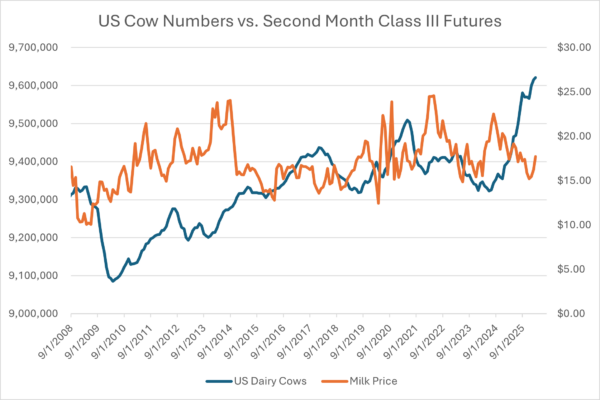
Source: USDA and Barchart
Is Milk Supply Down despite the Increase in Herd Size?
It’s fair to wonder if it is possible that milk supply is not keeping pace with the increase in herd size. After all, low supply can contribute to higher prices.
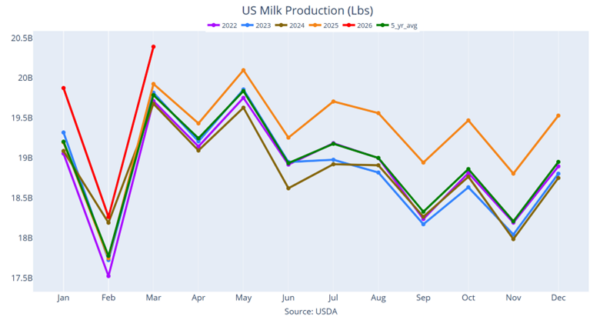
And the answer, resoundingly, is no. If you look at the chart below, U.S. milk production this year (in red) far outpaces prior year levels. Furthermore, rising milk output is unquestionably a direct result of a growing dairy herd in the U.S. As of March 2026, milk production in the U.S. was reported at a record high 20.391 billion pounds. Per cow production, at a near record 2,119 pounds per cow, has clearly benefited from better genetics and feed products within the dairy industry.
Is Milk Demand Supporting Higher Prices?
If supply is up and the industry is still experiencing an increase in price, that can only mean that the demand for milk AND milk products is outpacing the increased supply of milk. The data confirms this, although not necessarily as you imagine.
Rather than an increase in domestic demand, the recent increase in price is largely driven by strong export demand. However, the story is not that the world is increasing its demand for dairy products in general. Instead, the world demand for U.S. dairy products specifically is increasing on the heels of a weaker dollar. For much of 2023 and 2024, the U.S. Dollar Index was trading in a range of roughly 101 to 110. However, since breaking support, the Dollar has settled below that 101 level and currently trades around 98 (source: Google Finance), causing U.S. dairy prices to be heavily discounted compared to global competition. This discount positions the U.S. as the best-priced global choice for cheese, butter and powder against non-U.S. competitors. As a result, exports are exceptionally high and prices overall have risen in response.
- Milk powder posted an all-time high on April 23 at $2.26/lb on a combination of higher demand following lower production, contributing to the Class IV milk market overall. (See the chart below.)
- Cheese has been creeping back into the $1.60/lb range, which is good news for Class III milk prices.
- Per the USDA’s Cold Storage reports, both cheese and butter stocks are currently at 5-year lows.
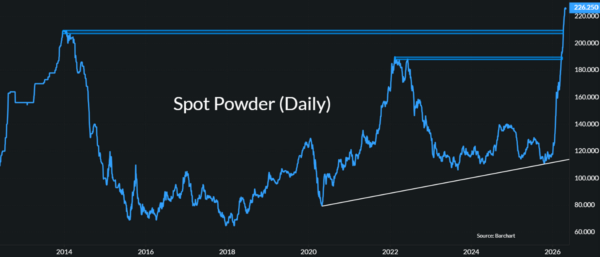
Chart Source: Barchart
There’s a Reason Total Farm Marketing Pays Attention to Over 40 Market Indicators
Earlier we talked about conventional wisdom and how an increase in supply is a good sign that prices will fall. While that can often be true, that same conventional wisdom can just as often blind us from other indicators and factors that stop us from capitalizing on opportunity. Even worse, it generates unwelcome anxiety that tells us good news in the market just can’t be true.
Bottom line, the market can appear fickle and mercurial, often because we rely on one or two factors to understand what’s happening instead of the interplay of all the factors that influence price. The good news is that right now, the market appears able to support increased U.S. milk production. In the meantime, we at Total Farm Marketing will continue to do what we always do – using analysis, both technical and fundamental, across 40 different market indicators that we believe matter in the market. We will continue to use data to drive our strategic approach to decision-making, and we will continue helping producers navigate the market and capitalize on opportunities.
Do you have questions about expectations, market reactions or our recommendations? We’re here to help.
Give Total Farm Marketing a call at 800.334.9779 to discuss your situation and how we can help you in your marketing decisions.
©May 2026. Total Farm Marketing. Futures and options trading involve significant risk of loss and may not be suitable for everyone. Therefore, carefully consider whether such trading is suitable for you in light of your financial condition. No representation is being made that scenario planning, strategy or discipline will guarantee success or profits. Examples of seasonal price moves or extreme market conditions are not meant to imply that such moves or conditions are common occurrences or likely to occur. Futures prices may have already factored in the seasonal aspects of supply and demand. The data contained herein is believed to be drawn from reliable sources but cannot be guaranteed. Reproduction of this information without prior written permission is prohibited. This material has been prepared by a sales or trading employee or agent of Total Farm Marketing and is, or is in the nature of, a solicitation. Any decisions you may make to buy, sell or hold a futures or options position on such research are entirely your own and not in any way deemed to be endorsed by or attributed to Total Farm Marketing. Total Farm Marketing refers to Stewart-Peterson Group Inc., Stewart-Peterson Inc., and SP Risk Services LLC. Stewart-Peterson Group Inc. is registered with the Commodity Futures Trading Commission (CFTC) as an introducing broker and is a member of National Futures Association. Stewart-Peterson Inc. is a publishing company. SP Risk Services LLC is an insurance agency and an equal opportunity provider. A customer may have relationships with any of the three companies.
SP Risk Services LLC is an insurance agency and an equal opportunity provider. Issuance of insurance coverage is subject to underwriting review and approval. SP Risk Services LLC is not licensed in all states. Please see the policy for the full terms, conditions, and exclusions. SP Risk Services LLC is an insurance agency licensed to sell certain insurance products and may receive compensation from insurance companies for such sales. Policy obligations are the sole responsibility of the issuing insurance company. Any coverage scenarios are hypothetical and shown for illustrative purposes only. Any claims made pursuant to any policy are adjusted by the issuing insurance company. Insured is responsible for accuracy of information provided to SP Risk Services and its insurance companies. The information included in or available through the website may include inaccuracies or typographical errors. SP Risk Services LLC may make changes or improvements to the website at any time. Information received via the website should not be the sole basis for risk management decisions. Consult a licensed insurance agent (which does not have to be an SP Risk Services LLC agent) for information and advice specific to your situation. Go to https://www.totalfarmmarketing.com/privacy-policy/ for Privacy Notice & Non-Discrimination Statement and https://www.totalfarmmarketing.com/terms-of-use/ for Terms of Use.
Author

Tanner Wilson